From zero to a submitted paper, in 9 phases and about 100 hours.
You learn each phase, do it on your own systematic review, and get a senior mentor exactly where you get stuck. Here's the whole path, step by step.
Most students take years.
Here's what's different.
The usual way
- Random YouTube tutorials and fragmented advice
- Waiting months for busy professors to reply to emails
- Guessing statistical models without formal training
- Desk-rejected by reviewers for methodological errors
Result: two years lost, and no publications.
The Tau Square way
- A fixed 9-phase pathYou always know the next step, and what "done" looks like before you move on.
- Doubt TokensA senior mentor unblocks you at the exact point you're stuck.
- The analysis, taught hands-onStatistical models you can defend, in RevMan and R.
- Writing for reviewersA manuscript framed to survive peer review.
Result: a manuscript ready to submit, in about 100 hours.
The exact 100-hour sequence
We provide the method, the templates and the hands-on training in RevMan, R and Rayyan. You provide the execution.
Your questionAbout 100 hours in allYour submission
Gap Identification
Systematic analysis of current literature to find a defensible, unanswered clinical question. Stop answering questions nobody is asking.
PICO & Protocol
Locking down the Population, Intervention, Comparison, and Outcomes. Registering the protocol to secure priority.
Search Strategy
Constructing Boolean strings across PubMed, Embase, and Cochrane. Building the net that catches everything relevant and nothing else.
Title/Abstract Screening
Using Rayyan to aggressively filter out noise. High-volume, high-accuracy sorting based on strict inclusion criteria.
Data Extraction
Pulling variables into the master PRISMA sheet. This is where papers are won or lost. Accuracy here dictates analytical success.
Risk of Bias
Applying Cochrane RoB-2 and MINORS tools. Evaluating the methodological integrity of the included papers.
Computational Engine
Hands-on statistical execution using RevMan and R. Generating forest plots, funnel plots, and running sensitivity analyses.
Manuscript Assembly
Translating data into academic prose. Structuring the narrative according to strict journal expectations.
Submission & Rebuttal
Navigating editorial portals and structuring bulletproof responses to Peer Reviewer 2. Crossing the finish line.
Before Phase 1 comes a free starter: Phase 0, Research From Zero (14 lessons, about 2 hours). Start Phase 0 free.
In the Accelerator, the cohort moves through it in 8 weeks.
A group that moves together, weekly calls, and a deadline that carries you to submission.
- Week 1Phases 1 and 2Your question and protocol
- Weeks 2–3Phases 3 and 4Search and screening
- Weeks 4–5Phases 5 and 6Extraction and risk of bias
- Week 6Phase 7The meta-analysis
- Week 7Phase 8The manuscript
- Week 8Phase 9Submission
Not ready by week 8?
The Accelerator Carryover: you join the next cohort free, and your unused Doubt Tokens come with you.
Prefer your own pace?
Foundations is self-paced, with 6 months of access. It starts the day you enrol, no cohort needed.
The system carries you.
People catch you when it can't.
Every plan gets the same system. What changes is how many people stand behind you.
Doubt Tokens
Stuck on your own project? Send the exact problem and a senior mentor sends back the fix, usually within 24 to 48 hours. 32, 8 or 3 tokens depending on your plan, and you can buy more anytime.
A cohort and a deadline
Eight weeks in a group that moves together, with weekly calls and a deadline that carries you to submission.
A senior mentor beside you
A senior mentor co-writes every manuscript with you: weekly 45-minute 1:1 calls, line-by-line editorial review, and a plan for several papers, not just one.
Two scholars who ran it from zero to an international stage
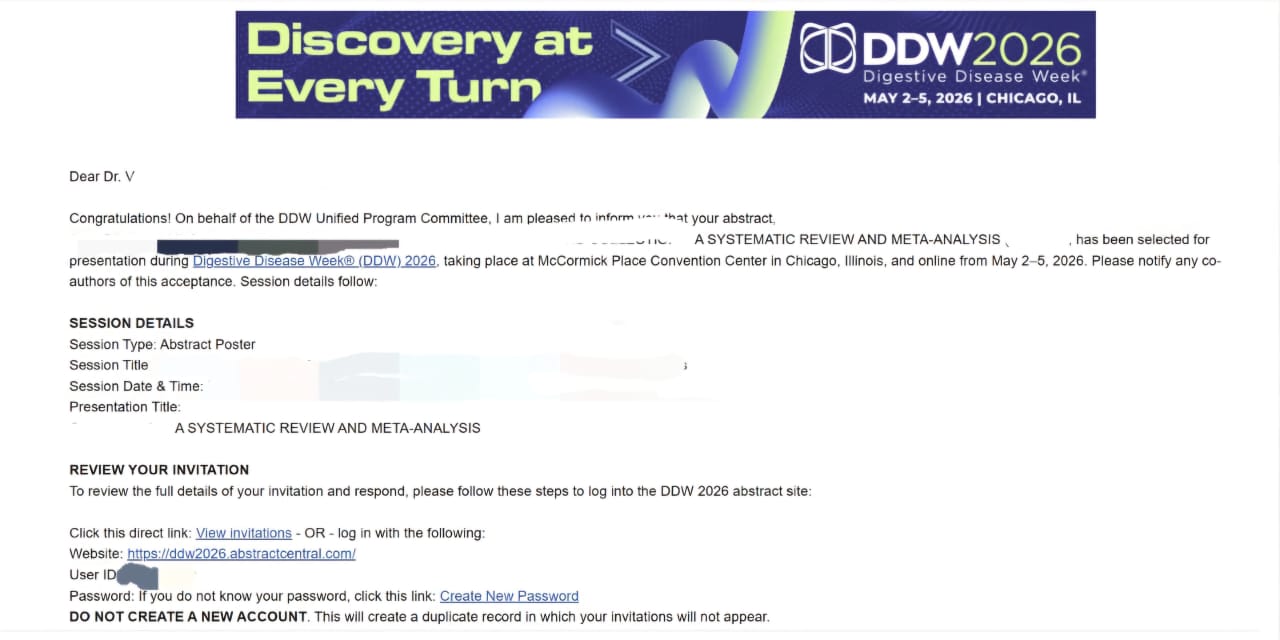
The graduated physician
Zero meta-analysis experience. Twelve months later, a project he conceived and ran on his own was accepted at Digestive Disease Week.
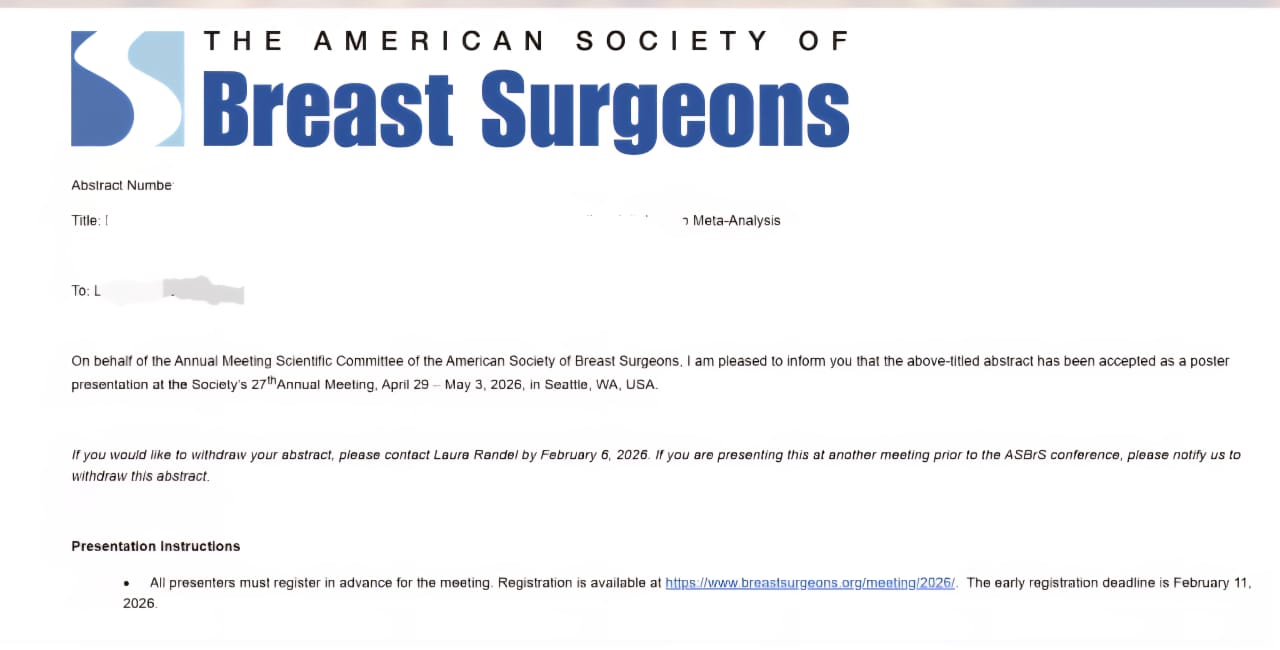
The third-year who was going nowhere
No professor gave her a real chance. She learned to build her own project, and presented her first-author meta-analysis at ASBrS.
You've seen the system and the proof.
Here are the three ways in, and the level of support each one gives you. Or try the teaching first, free.